Commiss.io is making it easier and safer to buy commissions, physical products, and digital downloads online. No account needed! - Read More »
How Much Does it Cost to Refinance a Mortgage?
DescriptionCreator Project Guidelines »
If you're anything like me, you probably look at today's mortgage rates and wonder, "Is it finally time to switch?" But here's the kicker that stops most of us in our tracks: the upfront cost. We all know refinancing isn't free, but pinning down the exact price tag can feel like trying to nail jelly to a wall.
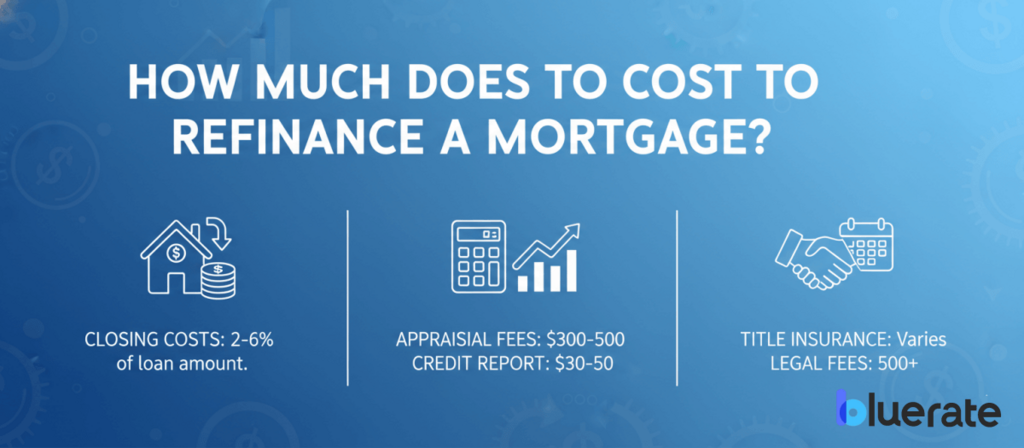
Generally speaking, you can expect to pay between 2% and 6% of your loan amount in closing costs. That's a wide gap, right? On a $300,000 home, that could be anywhere from $6,000 to $18,000. Because "national averages" are often too vague to be useful for your specific wallet, I always recommend skipping the guesswork. The only way to get a number you can actually bank on is to get a personalized quote. This is where I point friends to Bluerate. It's the smartest way to connect directly with loan officers and get a real, accurate figure without the headache.
What are Cost to Refinance a Mortgage?
Let's get down to the math. As I mentioned, the industry standard for refinancing costs lands squarely in that 2% to 6% range. To put that in perspective, if you are refinancing a mortgage with a balance of $400,000, you aren′t just paying a small administrative fee. You are likely looking at a bill between $8,000 and $24,000 due at closing. It's a significant investment, which is why knowing exactly where that money goes is crucial.
Most of that money isn't going into the lender's pocket. It's split among appraisers, local governments, and title companies.
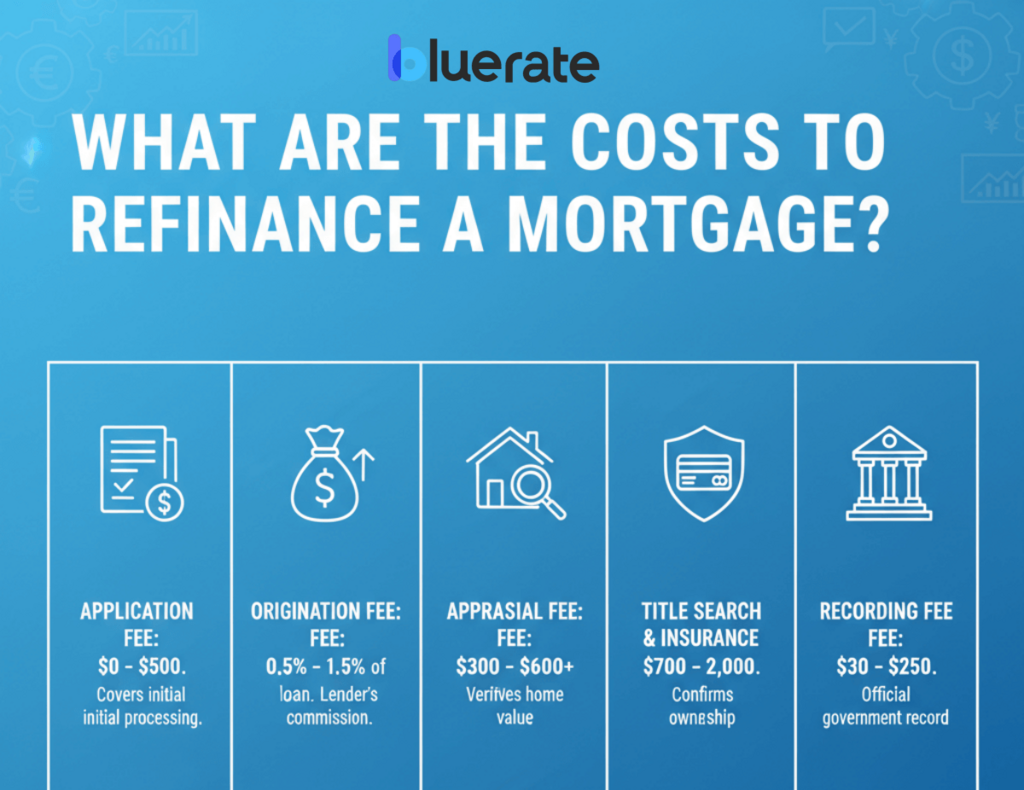
Here is a breakdown of the typical fees you'll see on your Loan Estimate:
- Application Fee ($0 – $500): This covers the initial processing of your request and checking your credit. Some lenders will waive this if you ask.
- Origination Fee (0.5% – 1.5% of loan amount): This is the big one. It's essentially the commission the lender charges for creating the loan. On a $300k loan, this fee alone can be $3,000.
- Appraisal Fee ($300 – $600+): Lenders need to verify your home's current market value to ensure they aren't lending more than the house is worth.
- Title Search & Insurance ($700 – $2,000): This confirms you legally own the property and protects the lender against any future claims or liens on the house.
- Credit Report Fee ($30 – $100): A small pass-through cost to pull your credit history from the major bureaus.
- Recording Fee ($50 – $250): Paid to your local city or county government to officially record the new mortgage usage.
What are the Factors that Affect the Refinance Cost?
You might be wondering why your neighbor paid $5,000 to refinance while your quote came in at $9,000. The truth is, your final bill depends heavily on your unique financial profile. Lenders price loans based on risk and effort.
Here are the five main factors that will swing that price up or down:
- Credit Score: This is the heavyweight champion of cost factors. If you have a score above 760, lenders view you as "low risk," which often translates to lower origination fees and better interest rates. If your score has dipped, you might see extra "discount points" added to your cost just to qualify.
- Lender: Not all lenders have the same overhead. Online lenders might have lower operating costs than a big bank with brick-and-mortar branches. Their fee structures vary wildly, which is why the first quote is rarely the best one.
- Type of Refinance: Are you just lowering your rate (Rate-and-Term), or are you pulling cash out for renovations (Cash-Out)? Cash-out refinances are viewed as riskier transactions, so they almost always come with higher rates or fees.
- Loan Size and Term: It's a balancing act. Larger loans ("Jumbo loans") often have stricter requirements and higher fees. Conversely, shortening your term (like switching from a 30-year to a 15-year) might get you a lower rate, but the closing costs generally remain similar as a percentage.
- Property Type: Refinancing your primary residence is usually the cheapest route. If you are refinancing an investment property, a vacation home, or a condo, expect to see "loan-level price adjustments" (LLPAs) that drive your costs up.
How to Reduce the Cost to Refinance?
Now for the part you actually care about: keeping more money in your pocket. While some third-party fees (like taxes and government recording fees) are set in stone, many others are negotiable or manageable. I've been through this process myself, and I've learned that you have more power than you think.
Here are eight ways to drive those costs down:
1. Improve Your Credit: Before you even apply, pull your credit report. If you see errors, dispute them. If your credit utilization is high, pay down a credit card balance. Boosting your score by even 20 points can sometimes knock huge fees off your loan estimate.
2. Pay Down Debt: Similar to your credit score, your Debt-to-Income (DTI) ratio matters. Lowering your monthly debt obligations can qualify you for programs with fewer fees.
3. Shop Around (The Smart Way): This is the single most effective way to save. Rates and fees vary massively. However, I usually warn people against filling out those generic "get quotes now" forms on random websites. You end up with your phone blowing up with spam calls. Instead, I recommend using Bluerate. It's different because it's not a lead-selling machine. You can browse and directly contact specific loan officers who fit your needs. It puts the control back in your hands, allowing you to quickly compare transparent quotes from different professionals without the harassment.

4. Borrow Less of Your Home's Value: If you can keep your loan balance at 80% or less of your home's value (LTV), you avoid Private Mortgage Insurance (PMI) and often get better rate pricing.
5. Avoid Cash-Out Refinances: If your main goal is just to lower your monthly payment, stick to a standard "rate-and-term" refinance. Tapping into your equity via a cash-out refi almost always triggers higher fees.
6. Consider a Streamline Refinance: If you currently have an FHA or VA loan, look into an FHA Streamline or VA IRRRL. These programs are designed to be fast and cheap, often skipping the appraisal and extensive income verification.
7. Negotiate Closing Costs: Yes, you can haggle! Look at the "Origination Fee" on your loan estimate. Ask the lender if they can lower it to win your business. If you have a quote from a competitor (thanks to Bluerate), use it as leverage.
8. Ask for Fee Waivers: specific lenders offer "loyalty discounts" if you already bank with them, or they might have seasonal promotions where they waive the application or appraisal fee. It never hurts to ask.
When is It Worth It to Refinance?
Just because you can refinance doesn't mean you should. For me, the decision always comes down to the "Break-even Point." This is simple math that tells you how long it will take for your monthly savings to pay off the upfront cost of the new loan.
The Formula:Total Closing Costs ÷ Monthly Savings = Months to Break Even
For example, if refinancing costs you $4,000 upfront but saves you $200 per month, your break-even point is 20 months ($4,000 / $200 = 20).
The Rule of Thumb: If you plan to stay in your home longer than that break-even period (20 months in this case), refinancing is likely a smart financial move. If you plan to sell the house next year, you'd actually lose money by refinancing. Also, consider non-monetary value: sometimes it's worth the cost just to switch from an unpredictable Adjustable Rate Mortgage (ARM) to a stable Fixed Rate, purely for peace of mind.
FAQs About Cost to Refinance Mortgage
Q1. What are the fees when refinancing?
The main fees include the Origination Fee (lender commission), Appraisal Fee (valuing the home), Title Insurance (legal protection), and Credit Report/Application Fees. You may also see prepaid items like property taxes and homeowners insurance required to set up your new escrow account.
Q2. What is the 80/20 rule in refinancing?
The 80/20 rule refers to the Loan-to-Value (LTV) ratio. Ideally, you want to keep your loan amount at or below 80% of your home's value, leaving you with 20% equity. Maintaining this ratio usually allows you to avoid paying for Private Mortgage Insurance (PMI), significantly lowering your monthly costs.
Q3. What disqualifies you from refinancing?
You might be disqualified if you have a low credit score (typically under 620), a high Debt-to-Income (DTI) ratio, or insufficient equity (being "underwater" on your mortgage). Unstable employment history or a recent bankruptcy can also be major roadblocks for lenders.
Q4. Can I refinance a mortgage with no closing costs?
Technically, yes, but there's a catch. A "no-closing-cost" refinance doesn't mean the fees disappear. Instead, the lender either rolls the fees into your total loan balance (so you pay interest on them) or gives you a slightly higher interest rate in exchange for covering the upfront costs.
Final Word
Refinancing is a powerful tool, but it's not a magic wand. It requires an upfront investment that usually lands between 2% and 6% of your loan balance. Is it worth it? The answer lies entirely in your break-even math and your future plans for the home.
Don't let the fear of costs keep you from potential savings, but don't fly blind either. The specific loan officer you choose makes a massive difference in what you ultimately pay. My advice? Don't just take the first offer. Head over to Bluerate, find a top-rated loan officer, and get a clear, accurate quote today. Your wallet will thank you later.
Previews
About the Creator
